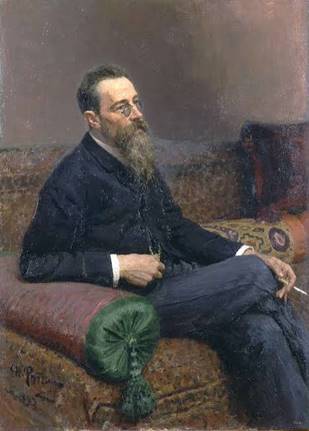
Portraits of the overman: Nikolay Rimski-Korsakov
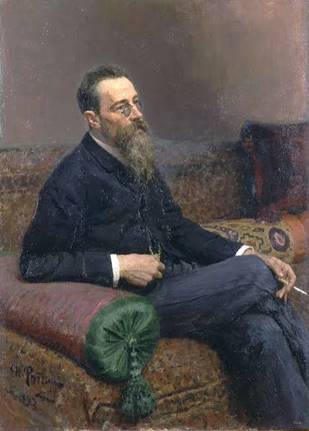
Nikolay Rimski-Korsakov
The composer who recreated magic into music
Who is he?
Nikolay Andreyevich Rimsky-Korsakov (1844–1908) was one of the most important Russian composers of the nineteenth century.
Why is he an overman?
Nikolay Rimsky-Korsakov was significant because he helped establish a distinctive Russian national style of classical music. As a member of “The Five,” he and other Russian composers sought to move away from simply imitating Western European traditions and instead drew inspiration from Russian folk songs, history, legends, and fairy tales.
Rimsky-Korsakov seems to have been a quiet, disciplined, intelligent, and somewhat reserved person. He was also curious and imaginative. His fascination with the sea, Russian folklore, fairy tales, and the supernatural found its way into his music. In his personal relationships, he was devoted to his family and particularly close to his wife, Nadezhda.
Curious facts:
He loved magic, legends, and fairy tales. Many of his operas are based on Russian folklore and fantastic stories. The Tale of Tsar Saltan, for example, includes the famous “Flight of the Bumblebee.”
He was considered a master of orchestration. Rimsky-Korsakov had an extraordinary ability to combine instruments to create vivid colors and atmospheres. He even wrote a famous textbook, Principles of Orchestration, which influenced generations of composers.
He sometimes got into trouble with the authorities.In 1905, students at the St. Petersburg Conservatory participated in protests against the Russian government. Rimsky-Korsakov supported the students, which contributed to his dismissal from the conservatory for a period.
Important work:
Scheherazade
The Snow Maiden
The Tale of Tsar Saltan
Short biography:
18 March 1844 – 21 June 1908
Nikolay Andreyevich Rimsky-Korsakov was born in Tikhvin, Russia, into a family with a long tradition of government and military service. Although he showed an early interest in music and began piano lessons at the age of six, his family expected him to pursue a naval career. During his studies, however, his passion for music grew, and in 1861 he met the composer Mily Balakirev, who became an important mentor.
Rimsky-Korsakov eventually joined “The Five,” a group of Russian composers who sought to develop a distinctly national style of music. In 1871, he became a professor of composition and orchestration at the St. Petersburg Conservatory. Although he initially lacked formal musical training, he recognized his weaknesses and undertook an intensive period of self-education in harmony, counterpoint, and composition.
In 1872, he married Nadezhda Purgold, a highly accomplished pianist and musician whom he had met through the musical circles of St. Petersburg. Nadezhda was not only his wife but also an important musical collaborator and critic. The couple had seven children, including Mikhail, who became an entomologist, and Andrey, who later became a musicologist and wrote extensively about his father’s life and work.
In his later years, Rimsky-Korsakov continued composing, teaching, conducting, and writing about music. He became an important influence on younger Russian composers, including Igor Stravinsky, and his approach to orchestration had a lasting impact on twentieth-century music.
