
Portraits of the overman: Sándor Petőfi
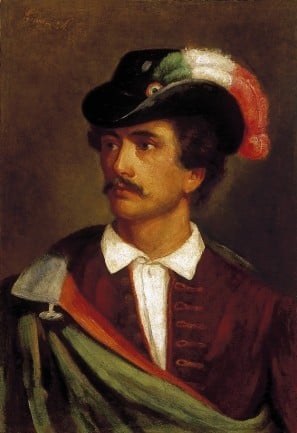
Sándor Petőfi
The poet who is free as the clouds
Who is he?
Sándor Petőfi was a Hungarian revolutionary and poet who became a national symbol of freedom.
Why is he an overman?
Sándor‘s poetry used a direct language that resonated with everyday Hungarians. He was a leading voice of the revolution and became a symbol of resistance and national pride. When he recited his poem Nemzeti dal in Budapest on March 15, 1848, it sparked mass demonstrations and marked the start of the revolution.
The themes in his poetry revolve around freedom, patriotism, love, nature, and social justice. Sándor speaks from his soul, as a person whose only idea of what is right in life is to be free. He has a strong connection with nature and as every deeply self-knowing person identifies himself with trees, birds, clouds, etc. Unsurprisingly, he has a difficult relationship with mankind as he sees all the greatness humans are capable of but cannot forgive them for choosing to be cruel or servile.
Curious facts:
As the circumstances surrounding his death at the Battle of Segesvár are not entirely clear, theories have emerged over the years that he survived and was taken as a prisoner to Siberia. Although they have never been proven, these rumours keep the mystery of his fate alive and contribute to his almost mythical status in Hungarian history.
Quotes:
Freedom and love
Are dear to me;
My life I give,
Sweet love, for thee,
Yet love I give
For liberty.
Liberty and Love
I’ll be a tree, if you are its flowers,
Or a flower, if you are the dew;
I’ll be the dew, if you are the sunbeam,
Only to be united with you.
I’ll be a tree
Maybe there’s something more
That mirrors what I am—
Like my own eyes, they carry
Both mist and sudden flame.
Clouds
Short biography:
01 January 1823 – 31 July 1849
Sándor Petőfi was a Hungarian poet, revolutionary, and national hero. Born in Kiskőrös to a butcher and innkeeper, his early life was marked by financial instability and frequent moves. Despite hardships, he pursued education and developed a strong love for literature and the performing arts.
He married Júlia Szendrey in 1847, and their passionate relationship was a frequent subject of his poems. Together they had a son, Zoltán, born in December 1848. Sándor’s personal life and ideals were closely entwined—he believed in equality, liberty, and the power of the written word to change society.
Tragically, Sándor disappeared during the Battle of Segesvár in 1849, at just 26 years old, and is believed to have died in combat, though his body was never found.
Notable work:
National song
Clouds
Liberty and love
The world and I
Song of the wolves
