
Portraits of the overman: Raffaello Santi
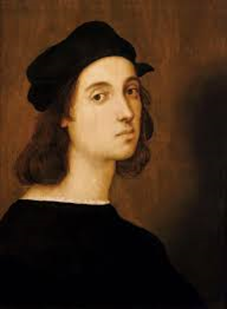
Raffaello Santi
The artist, who painted godhood
Who is he?
Raffaello Santi was one of the most influential artists of the Renaissance, notable especially for his ability to give holiness to the faces of the figures in his paintings.
Why is he an overman?
Raphael reveals what beauty and purity in art really mean. His faces, especially of his Madonnas, are so translucent like sunlight know that this is where it should focus and creates a halo of innocence and sacredness. Raphael has the unique gift to portrait divinity in his paintings and the only explanation for this is that he carries a flame of this divinity in his own soul.
A prominent figure in 16th-century Rome, his personality is controversial. He enjoys popularity and spends his time in rather frivolous activities, strongly opposing the brooding and introverted Michelangelo. However, when he sneaked in secret to see Michelangelo’s Sistine Chapel, he was so impressed by his talent, that he added his rival’s face to Тhe School of Athens Painting as Heraclitus. Although Raphael never suffered from modesty, his real confidence shines through the fact that he can recognize another genius as an equal.
Short biography:
1483 – 06 April 1520
Raffaello Santi, also known as Raphael, was born in Urbino, Italy. His father, Giovanni Santi, was a court painter, and introduced him to the basics of art. After his father’s death in 1494, Raphael apprenticed with Pietro Perugino in Perugia where his talent was quickly recognized.
By his early twenties, Raphael had already gained a reputation as a master. He moved to Florence around 1504, where he was inspired by the work of Leonardo da Vinci and Michelangelo. During this period, he developed his distinctive style. In 1508, Raphael was summoned to Rome by Pope Julius II to work on the Vatican Palace. There, he produced some of his most famous frescoes, including The School of Athens. He also became the chief architect of St. Peter’s Basilica in 1514, succeeding Donato Bramante.
Known for his charm, good looks, and affable nature, Raphael moved easily in elite circles and was a favorite of popes and patrons alike. His gracious personality helped him secure influential commissions and lasting friendships. Though he never married, Raphael’s had a famous love affair was with Margherita Luti, who is believed to have been the model for several of his works, including the sensual La Fornarina painting. According to his biographer Vassari, Raphael loved her until the end of his life and even refused to paint if she was not present in the room.
Notable work:
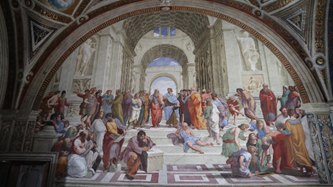
The School of Athens
Apostolic Palace, Vatican City
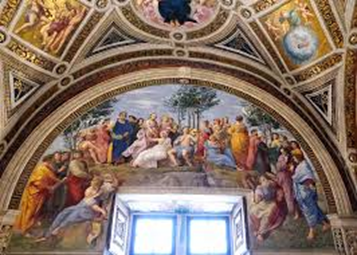
The Parnassus
Apostolic Palace, Vatican City
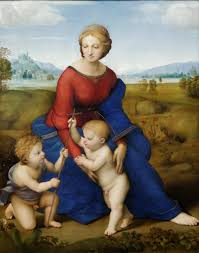
Madonna of the Meadow
Kunsthistorisches Museum, Vienna
Madonna with the Blue Diadem
Louvre, Paris
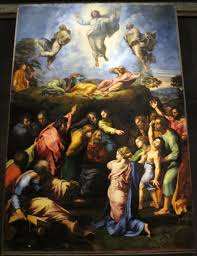
The Transfiguration
Pinacoteca Vaticana, Vatican City
