

Portraits of the overman: Martin Heideger
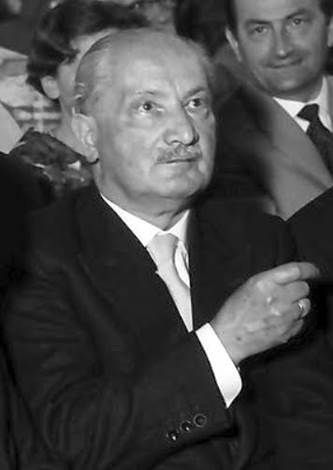
Martin Heideger
The philosopher who denied herd mentality
Who is he?
Martin Heideger is one of the most influential philosophers of the 20th century.
Why is he an overman?
Martin Heidegger fundamentally redirected 20th-century Western philosophy away from abstract theories of knowledge toward the concrete question of what it means to be. His masterpiece Being and Time laid the intellectual foundation for nearly every major continental movement that followed.
Heidegger pioneered a prescient critique of modern technology and environmental exploitation, warning that technological thinking reduces both nature and humanity to raw resources waiting to be consumed. He also developed the concept of Das Man, pointing to individuals who surrender their authentic personal responsibility and blend into a leveled-down, unexamined herd mentality.
Curious incidents:
Heidegger was famous for cultivating a rustic, Black Forest peasant persona—even in formal academic settings. When invited to lecture in major cities, he would occasionally show up wearing traditional Swabian peasant garb (Tracht).
Tired of decades of rumors and attacks over his Nazi past, Heidegger agreed to a long, defensive interview with the German magazine Der Spiegel—on the strict condition that it could not be published until after his death. Published in 1976 five days after he died, the interview included his famous, fatalistic declaration regarding modern technology and humanity’s plight: “Only a god can save us.”
Quotes by him:
Why are there beings at all instead of nothing? That is the question.
The possible ranks higher than the actual.
Beauty is one way in which truth occurs as unconcealedness.
Tell me how you read, and I will tell you who you are.
Important work:
Being and Time
The Origin of the Work of Art
Letter on Humanism
Short biography:
26 September 1889 – 26 May 1976
Martin Heidegger was bornin the rural town of Meßkirch in Germany, where his father worked as the sexton of the local Catholic church. Raised in a devoutly Catholic household, Heidegger initially trained for the priesthood and entered a Jesuit novitiate before health issues and a shifting intellectual focus led him away from theology. He studied philosophy at the University of Freiburg,before serving in a meteorological unit during the final months of World War I.
In 1917, he married Elfride Petri, a Protestant economics student. The couple raised two sons, Jörg and Hermann, in a marriage that endured throughout their lives despite Heidegger’s famous and deeply consequential romantic affair in the mid-1920s with his brilliant Jewish student, Hannah Arendt.
Heidegger’s academic rise began at Freiburg as an assistant to Edmund Husserl, the founder of phenomenology, before he took a professorship at the University of Marburg in 1923. It was during this period that he published his 1927 magnum opus, Being and Time (Sein und Zeit), a dense, revolutionary inquiry into the nature of human existence (Dasein) that instantly established him as one of the most influential thinkers in continental philosophy.
In April 1933, shortly after Adolf Hitler became chancellor, Heidegger was elected rector of the University of Freiburg. In his later decades, Heidegger largely retreated from public controversy to focus on his “later philosophy,” exploring language, poetry, art, and the dangers of modern technological thinking.