
Portraits of the overman: Giordano Bruno
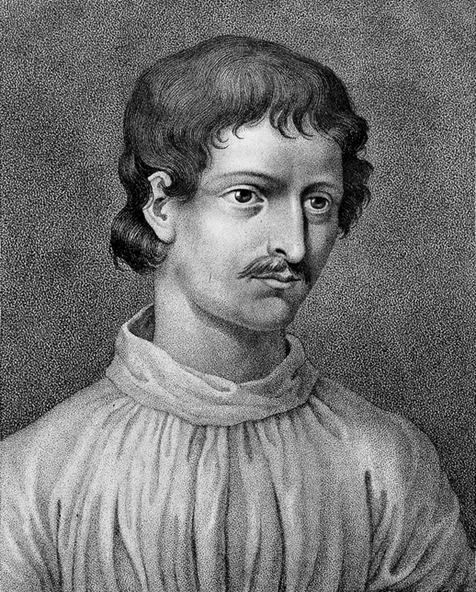
Giordano Bruno
The scientist who new the place of Earth and the human soul in the Universe
Who is he?
Giordano Bruno was an Italian philosopher, mathematician, and astronomer whose ideas were considered revolutionary in his time.
Why is he an overman?
Giordano Bruno was one of these people who are fully aware of the magical essence of the Universe and the interconnectedness of all things. Far before the time of these ideas had come, he told the truth about the human soul to the world. He promoted the idea of an eternal, ever-expanding universe, where God was immanent in nature, while rejecting the notion of a finite, static cosmos.
Bruno’s fearlessness was one of his most defining characteristics. He did not hesitate to publicly criticize the Catholic Church for what he saw as its dogmatic control over knowledge. His unflinching stance, particularly on issues like the infinite universe, the heliocentric model, and pantheism, made him a target for the Inquisition. Even when faced with the threat of execution, he refused to recant his beliefs.
Curious facts:
He developed his own memory system, known as the “memory palace” or “method of loci.” This technique involved associating information with specific locations in a mental “palace” or spatial layout, allowing someone to recall vast amounts of information. Bruno’s version of this method was particularly advanced and is considered one of the earliest forms of what we now call mnemonic devices.
Quotes:
The universe is infinite, and it contains an infinite number of worlds, and all of them are filled with souls and minds.
Knowledge is the food of the soul.
The greatest and most important thing is to be the master of one’s own mind.
God is the principle of the universe, not a creator who is separate from it. God is in everything.
I am more afraid of the complacency of the good than the animosity of the wicked.
The universe is a divine book, open to all who know how to read it.
Short biography:
1548 – 17 February 1600
Born in Nola, near Naples, Bruno joined the Dominican Order at a young age, but his radical views eventually led to his expulsion from the religious order. He traveled across Europe, studying in cities like Paris and London, where he immersed himself in the works of Copernicus, Galileo, and other early proponents of heliocentrism.
Bruno is best known for his cosmological theories, particularly his belief in an infinite universe, which challenged the geocentric view of the cosmos that was dominant in the Catholic Church. He proposed that the stars were distant suns with their own planets and that life could exist elsewhere in the universe, a bold idea that prefigured modern cosmology.
He was known for his passionate and often combative nature, which made him both a sought-after teacher and a controversial figure. While in Paris, he gained some recognition for his work in philosophy and mathematics, and he spent time teaching at various universities. However, his radical ideas about the universe, the nature of God, and human knowledge alienated him from both the Catholic Church and Protestant authorities, who saw him as a dangerous heretic.
Bruno’s challenges to the Church’s dogma, including his rejection of the literal interpretation of the Bible, made him a target for religious authorities. In 1593, he was arrested by the Roman Inquisition and, after a lengthy trial, was condemned for heresy.
He was burned at the stake in Rome, a martyr for free thought, scientific inquiry, and religious dissent. Despite his death, Bruno’s ideas had a lasting impact on the development of modern science and philosophy.
