
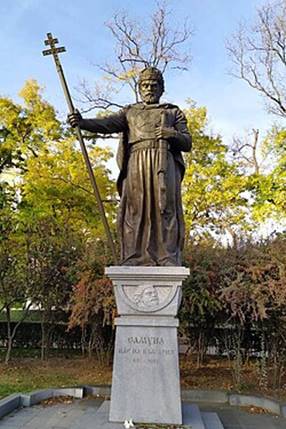
Portraits of the ovrman: Tsar Samuil
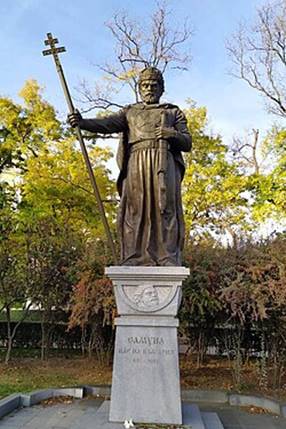
Tsar Samuil
The ruler with the most romantic fate
Who is he?
Tsar Samuil is one of the most important monarchs of the First Bulgarian Tsardom.
Why is he an overman?
Tsar Samuil is a symbol of an irrepressible spirit, statesmanship resilience, and the national will for freedom. In his long-standing wars with Byzantium, Samuil demonstrated military flexibility, organizing guerrilla warfare, ambushes in mountain passes, and lightning counteroffensives. His death proves that his heart beat in unison with the fate of his subjects.
Curious facts:
In Bulgarian folklore, there is also the famous legend of Samuil and the maiden Bilyana, which describes a beautiful love between the tsar and a local maiden. The legend shows how the image of Samuil lived in the minds of the people not only as a strict sovereign, but also as a person with deep feelings.
According to the Chronicle of the Priest of Duklja, when Samuil captured the Serbian prince Jovan Vladimir and threw him into prison in Prespa, his daughter Kosara visited the prisoners, fell in love with him, and threatened her father that she would take her own life if he did not marry her to the prince. Samuil relented, restored Jovan Vladimir’s lands, and made him his vassal and son-in-law.
Short biography:
958 – 06 October 1014
Tsar Samuil began his political and military rise as one of the Comitopuli—the sons of the provincial governor Count Nikola—who took over the governance of Bulgaria’s western lands after the fall of Eastern Bulgaria under Byzantine rule. Following the deaths of his brothers David, Moses, and Aron, Samuil emerged as the sole leader and de facto ruler of the state, even though he formally crowned the captive Roman as tsar as a sign of continuity. After Roman’s death in 997, Samuil was officially proclaimed Tsar of the Bulgarians, moving his capital sequentially to Prespa, Ohrid, and Bitola.
His reign was marked by continuous, nearly four-decade-long fierce wars against the Byzantine Emperor Basil II, known as the “Bulgar-Slayer.” Samuil established himself as a brilliant military commander and strategist who organized a large-scale defense and inflicted a series of heavy blows on the Byzantine army, including the legendary victory at the battle of the Gates of Trajan in 986, where Basil II barely managed to escape.
Samuil married Agatha, the daughter of John Chryselios. The marital alliance carried a strong political dimension, strengthening Bulgarian influence along the Adriatic coast.
The tragic climax of his reign came on July 29, 1014, at the Battle of Kleidion (the village of Klyuch), where the Byzantines managed to bypass the Bulgarian defensive fortifications and captured tens of thousands of Bulgarian soldiers. Driven by cruel vengeance, Emperor Basil II blinded the captured Bulgarian army, leaving one one-eyed guide for every hundred soldiers to lead them back to their tsar. According to historical chronicles, when Samuil saw this terrifying and unprecedented sight, his heart could not bear it, and he suffered a massive heart attack.